Policies, procedures, and documented evidence are the foundation of any compliance program. They capture intent: what your organisation has decided to do, how a control is designed, what "good" is supposed to look like. That foundation doesn't go away, and it isn't being replaced by anything we're announcing today.
But intent written down in Q1 doesn't tell you whether a control is still true in Q3. Someone reconfigures a permission. A device falls out of patch compliance. An access policy gets a quiet exception that never makes it back into the document. None of that is a failure of your policies, it's just what happens in a live environment. The gap isn't between good evidence and bad evidence, it's between evidence that was true once and evidence that's true today.
What we built
Live Integrations is CyberHeed reading directly from the systems you already run, identity, endpoint, and development tooling to start, and feeding what it finds straight into the compliance brain alongside your existing policies and documents.
The point isn't to collect more data. Plenty of tools will happily pull a feed from every system you own and hand you a dashboard. The harder problem, and the one the compliance brain is actually built to solve, is deciding what matters for your organisation: which systems are relevant to which controls, what specific data from each one actually answers a requirement, and whether what's been collected is sufficient to make a judgement, or just a starting point. That's context, not a generic mapping table, and it's the difference between an integration and an answer.
How it works
- Connect the systems you already run. Live Integrations reads configuration and state directly from your identity, endpoint, and development tooling. No exports, no manual screenshots.
- The brain decides what's relevant. Each connector supports a set of topics, identity, endpoint state, vulnerability posture, change history. Topics decide which of your controls a given connector can actually speak to, based on your framework and your environment, not a one-size-fits-all checklist.
- Drift gets flagged with context. The compliance brain evaluates the collected state against your controls and surfaces exposure the moment configuration diverges from what's expected, with remediation guidance that's specific to what changed and why it matters for your compliance posture, not a generic "fix this" alert.
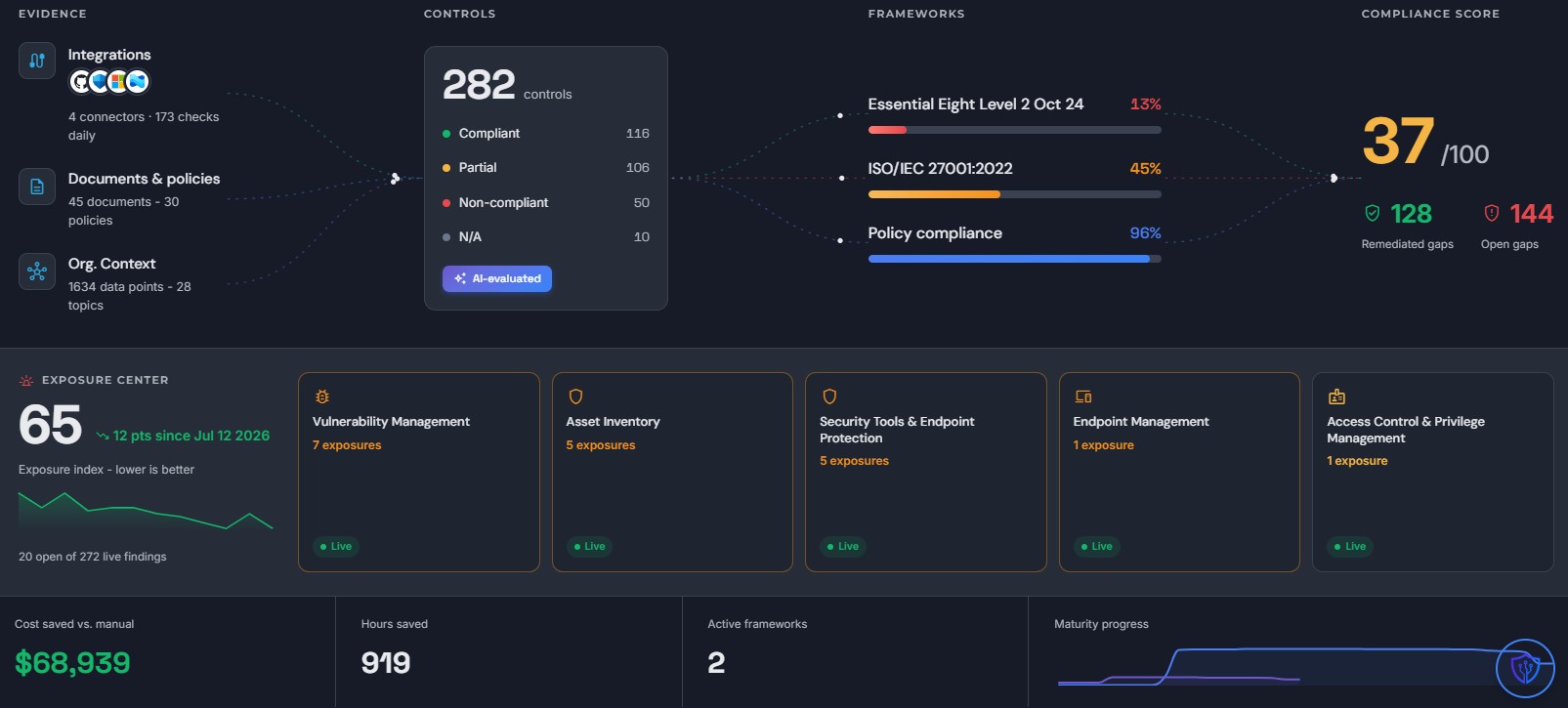
Live today
- GitHub: secure development practice, change management, identity and access evidence from your source control.
- Microsoft Defender for Endpoint: endpoint management, vulnerability, and asset inventory evidence.
- Microsoft Entra ID: identity, access, and conditional access configuration, the backbone of most access control evidence.
- Microsoft Intune: device compliance, endpoint management, and patch management evidence.
Coming soon
AWS, Google Workspace, Okta, and Jira are next on the roadmap, extending the same approach into cloud infrastructure, collaboration platforms, and change management tooling. See the full list of connectors, live and upcoming, on the Integrations page.
Why it matters
"GRC, but smart" means the platform should behave like it understands your organisation, not just your framework. Live Integrations is that principle applied to evidence: your policies and documents establish intent, live connectors confirm what's actually happening, and the compliance brain decides whether the two still line up, and exactly what to do if they don't.